
To check your progress, look at your stool and compare it to the chart below. We are aiming for a type three or type four stool, as these are the healthiest.
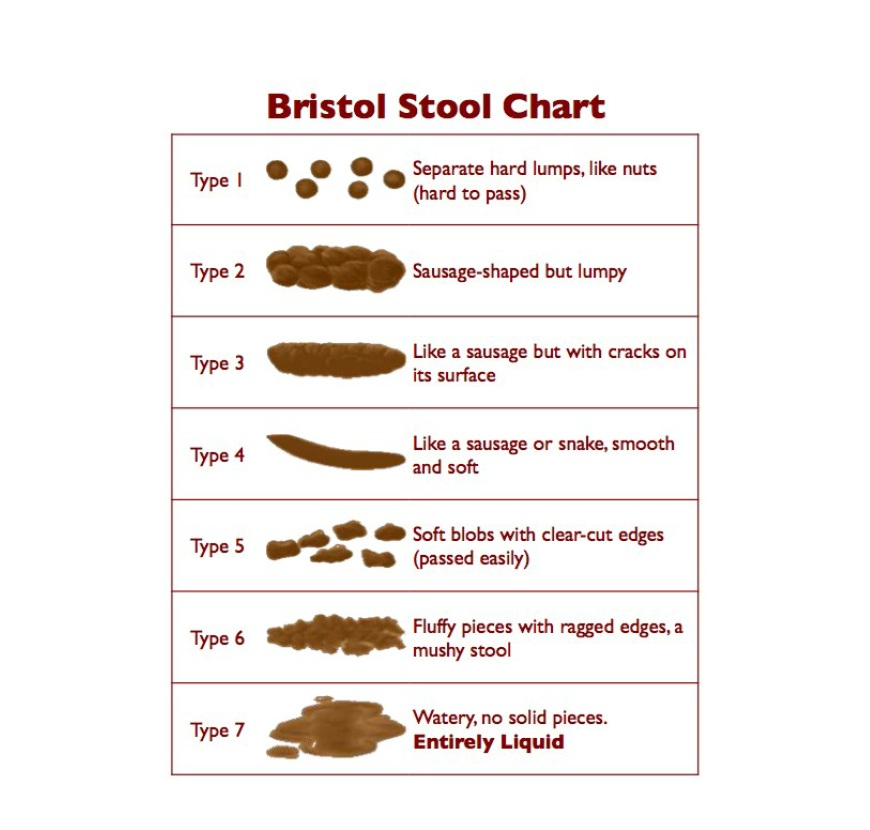
Please keep a food and symptom diary. This means writing down what you eat and how you feel. It helps you see if these changes make your tummy feel better.
🍽️ Eating Tips
- Eat small meals more often. This is easier on your tummy.
- Eat less high‑fibre food. This includes brown bread, brown rice, nuts and seeds.
- Cut down on artificial sweeteners. Especially sorbitol, which can upset your tummy.
- Eat less spicy and fatty food. Try to avoid things like:
- burgers and sausages
- chips and fast food
- ready meals, pies and batter
- cheese
- crisps, biscuits, cakes and chocolate
- creamy sauces
- Limit fruit. Have no more than three small portions a day. Spread them out.
- Choose different fruits. Eat fewer apples, mangoes and pears. Try oranges, raspberries or strawberries instead.
- Cut down on caffeine. Have no more than two mugs a day.
- Limit alcohol. No more than two units a day and have two days each week with no alcohol.
- Drink fewer fizzy drinks.
- If you have diarrhoea. Drink plenty of water so you don’t get dehydrated.
See links below:
IBS doesn’t happen because of stress, but stress can make it feel worse. Your brain and your gut are linked, so when you feel worried or upset, your tummy can react too. Many people notice their IBS gets worse when they are stressed.
Here are some simple ways to help your body stay calm:
🧘♀️ Calm Breathing and Relaxation
- Try slow, deep breaths.
- Sit quietly for a few minutes each day.
- You can also use a relaxation or mindfulness app to help you feel peaceful.
🌟 Mindfulness
Mindfulness means paying attention to your breathing and how your body feels. Doing this often can help your tummy feel better over time.
🤸 Gentle Exercise
Activities like yoga or tai chi use slow movements and calm breathing. Many people with IBS find these helpful.
😴 Sleep and Rest
Getting enough sleep is important. When you’re tired, your body can feel pain more easily, and stress feels bigger.
🎨 Fun and Hobbies
Doing things you enjoy - like hobbies, seeing friends, or relaxing - helps your body feel safer and calmer. This is not being “self‑indulgent”; it’s part of looking after yourself.
💬 If You Feel Anxious
If you often feel worried, talking to a professional can help. Some people use CBT (a type of talking therapy) to manage anxious thoughts, and there are even CBT apps made for people with tummy problems.
Useful websites and apps
- NHS East Cheshire Talking Therapies - The Big Life Group
- Stress - Every Mind Matters - NHS
- Calm: Sleep and Meditation (paid for app)
- Smiling Mind (free app)
- NERVA: Gut-brain therapy (paid for app)
See links below:
Urgency and Pelvic Floor Exercises
Your pelvic floor muscles help stop leaks from your bladder and bowel. Doing exercises every day can make them stronger.
See video from NHS Scotland: https://youtu.be/6Z5DZe1eH2Q
How to do them
Start sitting or lying down.
- Tighten the muscles around your bottom (as if stopping wind).
- Squeeze the muscles inside your vagina (don’t pull in your tummy).
- Do long squeezes and short squeezes.
Long squeezes
- Hold the squeeze for as long as you can (aim for 10 seconds).
- Rest for five seconds.
- Do this 10 times.
Short squeezes
- Squeeze for one second.
- Rest.
- Do this 10 times.
Try to do 10 long and 10 short squeezes, three times a day.
See your GP if you:
- Feel something coming down or out of your vagina or bottom.
- Find it hard to empty your bowel.
- Have pain in your bottom or bladder before or after defecating.
- Have pain during sex.
Physical activity
- All adults should stay active because it helps both the body and the mind feel good. Being active can also help people with IBS by lowering stress, easing bloating, and helping the gut work better.
- Adults should try to do 150 minutes of moderate activity each week. This means about 30 minutes a day on at least five days a week.
- Another way to reach this goal is by doing 75 minutes of harder (vigorous) activity each week, which gives the same health benefits.
|
Examples of moderate activities Be able to talk but not sing!
Walking briskly Gardening Cycling Dancing Water aerobics
|
Examples of vigorous activities Can only say a few words before pausing for breath
Running Swimming at a fast pace Cycling at a fast pace or on an incline Team sports such as netball or football |
Examples of strengthen activities Do at least two days per week
Lifting weights Carrying heavy shopping bags Heavy digging Yoga Body weight exercises such as press ups and sit ups |
Yoga
Yoga can help your body feel stronger and your mind feel calmer. It may help with IBS symptoms.
Sleep hygiene
People with IBS often sleep badly because of tummy pain or heartburn. Poor sleep can make IBS feel worse.
See your GP if you wake up in the night needing to defecate.
How much sleep do adults need?
Most adults need seven to nine hours.
How to sleep better
- Go to bed and get up at the same time every day.
- Relax before bed (no screens for an hour).
- Don’t eat big meals or drink alcohol close to bedtime.
- Avoid caffeine in the evening.
- Be active in the day, but not right before bed.
- Keep your bedroom quiet, dark and cool.
Here are some useful resources on sleeping better.
Fall asleep faster and sleep better - Every Mind Matters - NHS
Fall asleep faster and sleep better - Every Mind Matters - NHS – video
There are some medicines that can help ease diarrhoea as well as any tummy cramps, bloating, or trapped wind you may have. You can buy them from a shop or pharmacy or your GP may prescribe them for you.
|
Type of medicine |
How it works |
Examples |
|
Antimotility medicine |
Slows food down moving through your gut, so your stool is firmer |
Loperamide, Imodium |
|
Tummy muscle relaxers |
Help calm tight or cramping tummy muscles |
Buscopan, Mebeverine |
|
Peppermint oil capsules |
Help with bloating, trapped wind and tummy cramps |
Colpermin, Mintec |
|
Pain-relief |
Helps with mild tummy pain, but not strong cramps |
Paracetamol |
If your tummy problems do not get better with food changes or these medicines, it is a good idea to speak to your GP.
When to see your GP:
Talk to your GP if:
- Your symptoms do not get better with food changes or shop-bought medicines
- You often have strong tummy pain that stops you doing normal things
- You feel very bloated most days
- Your symptoms are getting worse or keep coming back
Your GP can help find out what is causing your symptoms and talk to you about other treatments.
Found a problem? Report it and help us to improve our website